If you're searching for Kimi K2.6 pricing, the key numbers are straightforward: $0.16 / 1M cached input tokens, $0.95 / 1M fresh input tokens, and $4.00 / 1M output tokens on Moonshot's current K2.6 pricing page.
That answers the "per million tokens" question. The next thing people usually mix up is whether they're looking at raw API billing, Batch API pricing, or a chat subscription plan. Those are different cost surfaces, and this is where a lot of K2.6 pricing posts get sloppy.
As of May 20, 2026, Moonshot's K2.6 pricing page reads:
- Input Price (Cache Hit): $0.16 / 1M tokens
- Input Price (Cache Miss): $0.95 / 1M tokens
- Output Price: $4.00 / 1M tokens
- Context Window: 262,144 tokens
And for comparison, K2.5 on the matching pricing page:
- Input Price (Cache Hit): $0.10 / 1M tokens
- Input Price (Cache Miss): $0.60 / 1M tokens
- Output Price: $3.00 / 1M tokens
- Context Window: 262,144 tokens
So the real question isn't "is K2.6 cheap?" It's three separate ones: how much more expensive it is than K2.5, whether that premium is worth it for your workload, and what changes once caching is in the picture.
New to Kimi K2.6? Try Kimi K2.6 for free.
Kimi K2.6 Pricing: Quick Answer
| Pricing surface | Current answer |
|---|---|
| Kimi K2.6 API cache-hit input | $0.16 / 1M tokens |
| Kimi K2.6 API cache-miss input | $0.95 / 1M tokens |
| Kimi K2.6 API output | $4.00 / 1M tokens |
| Batch API support | Both kimi-k2.6 and kimi-k2.5 are supported |
| Free vs paid on this site | /pricing uses chat credits and subscriptions, not raw token billing |
Kimi K2.6 Pricing at a Glance
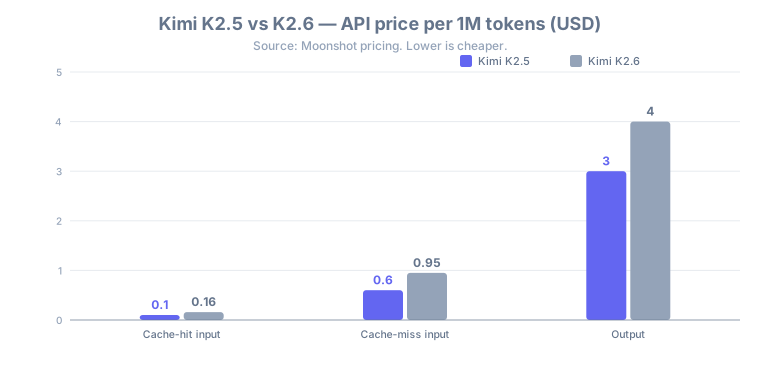
| Model | Cache Hit Input | Cache Miss Input | Output | Context |
|---|---|---|---|---|
| Kimi K2.5 | $0.10 | $0.60 | $3.00 | 262,144 |
| Kimi K2.6 | $0.16 | $0.95 | $4.00 | 262,144 |
Kimi K2.6 Free vs Paid: API Billing Is Not the Same as Chat Subscription Pricing
Moonshot's docs are about raw API billing. The /pricing page on this site is a different surface: Free gives you 3 credits, while paid plans range from 250 to 1000 monthly credits depending on tier.
That distinction matters because people often search "Kimi K2.6 pricing" when they really mean one of two different things:
- "What does Moonshot charge per million tokens?"
- "Can I use K2.6 on a free plan or a subscription instead of paying per token?"
If you need API math, keep reading this page. If you want subscription-style chat access, use the site pricing page instead.
How Much More Expensive Is K2.6 than K2.5?
On fresh (non-cached) input, K2.5 is $0.60/1M and K2.6 is $0.95/1M — about 58% more expensive on K2.6.
On cache-hit input, K2.5 is $0.10/1M and K2.6 is $0.16/1M, which works out to roughly the same relative bump — about 60% more.
Output tokens are where it narrows: K2.5 at $3.00/1M vs K2.6 at $4.00/1M, or about 33% more on K2.6.
Practical Cost Examples
Example 1: 1M fresh input + 200K output
K2.5
- Input: $0.60
- Output: 0.2 × $3.00 = $0.60
- Total: $1.20
K2.6
- Input: $0.95
- Output: 0.2 × $4.00 = $0.80
- Total: $1.75
Example 2: 10M fresh input + 2M output
K2.5
- Input: 10 × $0.60 = $6.00
- Output: 2 × $3.00 = $6.00
- Total: $12.00
K2.6
- Input: 10 × $0.95 = $9.50
- Output: 2 × $4.00 = $8.00
- Total: $17.50
That's a real bump, yes, but it's still nowhere near what you'd pay on frontier proprietary premium models like Claude Opus 4.7.
What You Actually Get for the K2.6 Premium
Moonshot's K2.6 docs are pretty consistent about where the extra spend is supposed to go — stronger long-horizon coding stability, better instruction following, better self-correction, and better autonomous agent execution.
So the right way to read K2.6 pricing is: you're paying for higher-end coding and agent reliability, not for a bigger context window. That distinction actually matters. Both K2.5 and K2.6 have the same 256K context. The premium here is about the quality of long-running work, not raw window size.
What Else the K2.6 Pricing Page Confirms
The K2.6 pricing page also spells out that K2.6 supports automatic context caching, ToolCalls, JSON Mode, Partial Mode, and internet search.
Worth paying attention to, because cost isn't just the per-token number. It's how well the model maps onto your actual production surface. If your app leans on long-running coding loops, structured outputs, tool calling, or repeated shared context, K2.6's higher unit price may still turn into the cheaper system-level choice once you factor in fewer retries, fewer failed runs, and less human cleanup.
One Important Pricing Footnote: Batch API
This part changed. Moonshot's current Batch API docs now say Batch API supports both kimi-k2.6 and kimi-k2.5.
The other useful detail is pricing: batch inference runs at 60% of the standard real-time model price, which effectively means a 40% discount if your workload does not need immediate responses.
So the real Batch API question is no longer "does K2.6 support it?" It does. The real question is whether K2.6's higher real-time price is still worth it for your workload after that batch discount is applied.
Should You Pay More for K2.6?
K2.6 is the right call when your workload is coding-heavy, when long-running agent execution quality matters, when fewer retries and better follow-through matter more than the absolute cheapest token rate, or when you're building something new and want Moonshot's current flagship.
K2.5 is the right call if cost sensitivity is your top priority, if your K2.5 workflow is already stable, or if you don't need the long-horizon coding upgrade badly enough to justify the premium.
Final Verdict
K2.6 costs more than K2.5. That part isn't complicated.
The numbers are $0.16 cache-hit input, $0.95 cache-miss input, and $4.00 output. The real question is whether the upgrade buys something useful for your workload: better long-horizon coding, better instruction following, more reliable agent execution.
If you want the lowest Moonshot bill, K2.5 still wins. If you care more about the quality of each run, K2.6 is the model Moonshot is clearly pushing as the new default.