If you're comparing Kimi K2.5 vs Claude, the real decision usually comes down to four things: price, coding benchmarks, context window, and whether you want open weights plus agent-swarm style workflows. That's the frame worth using here, not vague "which model is smarter?" arguments.
Kimi K2.5 from Moonshot AI brings Agent Swarm, a 256K context window, and a much lower posted API price than Claude's premium tiers. Claude, meanwhile, usually wins on safety positioning and has a mature developer mindshare advantage. This post is about where those tradeoffs actually show up in practice.
Kimi K2.5 vs Claude: At a Glance
Model Specifications Comparison
| Specification | Kimi K2.5 | Claude 4.5 | Claude 3.5 Sonnet |
|---|---|---|---|
| Parameters | 1T total / 32B active | Undisclosed | Undisclosed |
| Architecture | MoE (Mixture-of-Experts) | Transformer | Transformer |
| Context Window | 256,000 tokens | 200,000 tokens (default) | 200,000 tokens (default) |
| Training Data | ~15T tokens | Undisclosed | Undisclosed |
| Agent Swarm | Up to 100 agents | ⚠️ Sub-agents via Agent SDK/Claude Code | ⚠️ Sub-agents via Agent SDK/Claude Code |
| Open Weights | ✅ Modified MIT | ❌ Proprietary | ❌ Proprietary |
| Visual Coding | ✅ Native | ⚠️ Limited | ⚠️ Limited |
Context Window: The Critical Difference
Kimi K2.5's 256K Advantage (at default 200K Claude context)
The Kimi K2.5 vs Claude context comparison at default settings reveals Kimi's advantage:
Context Capacity Comparison:
┌─────────────────────────────────────────────────────┐
│ Kimi K2.5:     ████████████████████████████ 256K   │
│ Claude 4.5:    ████████████████████████ 200K       │
│ Difference:    ████████████ 56K (28% more)          │
└─────────────────────────────────────────────────────┘
Practical Impact:
- Kimi K2.5 can process approximately 600 pages of text in a single pass
- Claude's default context is approximately 500 pages (200K); some tiers also offer larger beta context windows
- Those extra 56,000 tokens enable comprehensive analysis of larger codebases and documents
Real-World Context Usage
| Use Case | Kimi K2.5 | Claude 4.5 | Winner |
|---|---|---|---|
| Large codebase analysis (500+ files) | ✅ Fits entirely | ⚠️ Requires chunking | Kimi |
| Multi-document legal review | ✅ 8 documents | ⚠️ 6 documents | Kimi |
| Book-length content creation | ✅ Full draft | ⚠️ Split processing | Kimi |
| Extended conversation history | ✅ 100+ turns | ⚠️ 80 turns | Kimi |
Coding Performance Comparison
SWE-Bench Verified Results
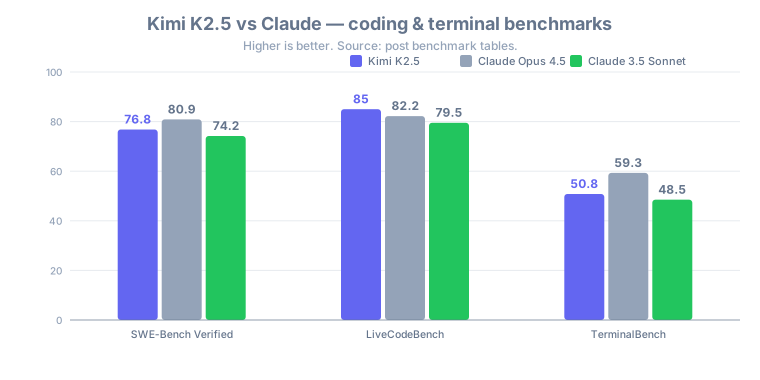
| Model | Score | Assessment |
|---|---|---|
| Claude Opus 4.5 | 80.9% | Highest on complex SE tasks |
| Kimi K2.5 | 76.8% | Strong performance |
| Claude 3.5 Sonnet | 74.2% | Good for general use |
While Claude Opus leads by 4.1 percentage points on software engineering benchmarks, Kimi K2.5's Agent Swarm can compensate through parallel analysis of code components.
LiveCodeBench Performance
| Model | Score | Assessment |
|---|---|---|
| Kimi K2.5 | 85.0 | Leader in competitive programming |
| Claude Opus 4.5 | 82.2* | Strong but trailing |
| Claude 3.5 Sonnet | 79.5* | Good performance |
Kimi K2.5 leads by 2.8 points in live coding scenarios, demonstrating superior algorithmic problem-solving capabilities.
Terminal and Tool Use
| Model | TerminalBench Score |
|---|---|
| Claude Opus 4.5 | 59.3 |
| Kimi K2.5 | 50.8 |
| Claude 3.5 Sonnet | 48.5 |
Claude Opus shows slightly stronger terminal command execution, though Kimi K2.5's parallel agent coordination often achieves faster overall task completion.
Agentic Capabilities: Kimi's Defining Advantage
Agent Swarm vs Sequential Processing
The most significant differentiator in Kimi K2.5 vs Claude is agentic workflow capability:
| Capability | Kimi K2.5 | Claude (All Versions) |
|---|---|---|
| Parallel Agents | Up to 100 | ✅ Supported (framework-driven sub-agents) |
| Self-Directed Workflows | ✅ Native | ✅ Supported via Claude Code / Agent SDK |
| Runtime Reduction | 80% faster | Baseline |
| Coordinated Tool Calls | ~1,500 per task | Supported (public upper bound not disclosed) |
| Workflow Adaptation | Dynamic | Static patterns |
Agentic Benchmark: HLE-Full with Tools
| Model | HLE-Full (w/ tools) Score | Assessment |
|---|---|---|
| Kimi K2.5 | 50.2 | Clear leader |
| Claude Opus 4.5 | 43.2 | Competitive |
| Claude 3.5 Sonnet | 41.5 | Good |
Kimi K2.5 leads Claude Opus by 7 points and Claude 3.5 Sonnet by 8.7 points in tool-augmented agentic tasks, demonstrating superior autonomous operation.
Reasoning and Knowledge
Mathematical Reasoning
| Benchmark | Kimi K2.5 | Claude Opus 4.5 | Claude 3.5 Sonnet |
|---|---|---|---|
| AIME 2025 | 96.1 | 92.8 | 89.5 |
| HMMT 2025 | 95.4 | 92.9* | 91.2* |
| IMO-AnswerBench | 81.8 | 78.5* | 76.3* |
Kimi K2.5 demonstrates superior mathematical reasoning across all major benchmarks, with particular strength in competition-level problems.
General Knowledge
| Benchmark | Kimi K2.5 | Claude Opus 4.5 | Claude 3.5 Sonnet |
|---|---|---|---|
| GPQA-Diamond | 87.6 | 87.0 | 84.2 |
| MMLU-Pro | 87.1 | 89.3* | 88.1* |
Results are mixed in general knowledge, with Kimi K2.5 leading on expert-level reasoning (GPQA-Diamond) while Claude models show stronger breadth of knowledge (MMLU-Pro).
Visual and Multimodal Capabilities
Document and OCR Performance
| Benchmark | Kimi K2.5 | Claude Opus 4.5 | Claude 3.5 Sonnet |
|---|---|---|---|
| OCRBench | 92.3 | 86.5* | 84.1* |
| OmniDocBench 1.5 | 88.8 | 87.7* | 82.5* |
Kimi K2.5 shows stronger document understanding in these reported results, with a 5.8-point lead on OCRBench and a 1.1-point lead on OmniDocBench 1.5.
Visual Coding Comparison
| Feature | Kimi K2.5 | Claude Models |
|---|---|---|
| Screenshot to Code | ✅ Native support | ⚠️ Basic description |
| Figma Integration | ✅ Direct import | ✅ Available via integrations |
| Design-to-React | ✅ Automated | ⚠️ Manual guidance needed |
| Responsive Generation | ✅ Built-in | ⚠️ Post-processing required |
Pricing: The Decisive Factor
API Pricing Comparison
| Model | Input (per 1M tokens) | Output (per 1M tokens) |
|---|---|---|
| Kimi K2.5 | $0.60 | $3.00 |
| Claude 3.5 Sonnet | $3.00 | $15.00 |
| Claude Opus 4.5 | $5.00 | $25.00 |
Cost Efficiency Analysis
Monthly Cost Comparison (10M input / 2M output tokens):

Kimi K2.5:        $ 12      ████████████████████
Claude 3.5:       $ 60      ████████████████████████████████████████████████
Claude Opus:      $100      ███████████████████████████████████████████████████████████████████████

Savings with Kimi K2.5:
vs Claude 3.5:    80% cheaper
vs Claude Opus:   88% cheaper
Kimi K2.5 is about 5x cheaper than Claude 3.5 Sonnet and 8.3x cheaper than Claude Opus 4.5, making it a strong choice for cost-conscious organizations.
Deployment and Accessibility
Kimi K2.5 Deployment Options
| Option | Availability | Best For |
|---|---|---|
| API Access | ✅ Global | Production applications |
| Open Weights | ✅ Modified MIT | Custom deployments |
| Cloud Partners | ✅ Multiple | Regional compliance |
| Local Deployment | ✅ 600GB+ required | Maximum data privacy |
Claude Deployment Options
| Option | Availability | Best For |
|---|---|---|
| Anthropic API | ✅ Global | Standard applications |
| AWS Bedrock | ✅ AWS regions | AWS-native stacks |
| Google Vertex | ✅ GCP regions | Google Cloud users |
| Open Weights | ❌ Not available | N/A |
When to Choose Kimi K2.5 vs Claude
Choose Kimi K2.5 When:
- ✅ You need 256K context for large documents
- ✅ Agent Swarm parallelization can benefit your workflow
- ✅ Cost efficiency is important (5-8.3x cheaper)
- ✅ You require open weights for compliance
- ✅ Visual coding and design-to-code are priorities
- ✅ Document OCR is a key use case
- ✅ You want mathematical reasoning advantages
Choose Claude When:
- ✅ You need the absolute highest SWE-Bench Verified score
- ✅ Safety alignment is your absolute top priority
- ✅ You prefer sequential reasoning with careful validation
- ✅ You're already invested in the Anthropic/AWS/Google ecosystem
- ✅ Budget is not a constraint for marginal benchmark gains
Performance Summary by Use Case
| Use Case | Best Choice | Key Advantage |
|---|---|---|
| Large codebase analysis | Kimi K2.5 | 256K context vs 200K |
| Complex refactoring | Claude Opus | 80.9% vs 76.8% SWE-Bench |
| Parallel data processing | Kimi K2.5 | Native swarm design and higher tool benchmark scores |
| Mathematical problem solving | Kimi K2.5 | 96.1 vs 92.8 AIME |
| Document processing | Kimi K2.5 | 92.3 vs 86.5 OCRBench |
| Cost-sensitive production | Kimi K2.5 | $0.60 vs $3-5 input |
| Safety-critical applications | Claude | Constitutional AI focus |
| Visual UI development | Kimi K2.5 | Native visual coding |
Conclusion
The Kimi K2.5 vs Claude comparison reveals two excellent but different approaches to AI. Claude prioritizes careful reasoning, safety alignment, and marginally higher scores on specific software engineering benchmarks. Kimi K2.5 offers superior value through:
- 28% larger context window (256K vs 200K)
- Revolutionary Agent Swarm technology (100 parallel agents)
- 80-88% cost savings depending on Claude version
- Open weights availability for compliance and customization
- Superior mathematical and document processing
For the vast majority of organizations, Kimi K2.5 provides the better overall package, combining competitive performance with unprecedented scalability and cost efficiency. Claude remains relevant for applications where Anthropic's specific safety approach justifies premium pricing.
Frequently Asked Questions
Is Kimi K2.5 better than Claude?
Kimi K2.5 outperforms Claude in default context length (256K vs 200K), cost efficiency (5-8.3x cheaper), mathematical reasoning (96.1 vs 92.8 AIME), document processing (92.3 vs 86.5 OCRBench), and tool-augmented agentic benchmark scores (50.2 vs 43.2 on HLE-Full w/ tools). Claude leads slightly in SWE-Bench Verified (80.9% vs 76.8%).
Why is Kimi K2.5 so much cheaper than Claude?
Kimi K2.5's Mixture-of-Experts architecture activates only 32B of its 1T parameters per token, making inference more efficient. Moonshot AI also prioritizes accessibility in their pricing strategy.
Can Kimi K2.5 replace Claude for coding?
Yes, for most coding tasks. Kimi K2.5 achieves 76.8% on SWE-Bench Verified (vs 80.9% for Claude Opus) and 85.0 on LiveCodeBench (vs 82.2% for Claude Opus), while offering unique visual coding capabilities and 5-8.3x lower costs.
Does Claude have anything like Agent Swarm?
Claude now supports multi-agent patterns through Claude Code and the Agent SDK (including subagents). Kimi K2.5's distinction is its native swarm-style orchestration and stronger reported tool-augmented benchmark score.
Which is better for enterprise deployment?
Kimi K2.5 is generally better for enterprise due to lower costs (enabling broader adoption), open weights (for compliance), larger context window, and superior document processing capabilities.