Kimi K2.5 vs GLM 4.7 represents the showdown between two of China's most advanced AI models. Both offer impressive capabilities, but understanding their differences is crucial for selecting the right model for your specific needs.
Overview: Kimi K2.5 vs GLM 4.7
Model Introductions
| Aspect | Kimi K2.5 | GLM 4.7 |
|---|---|---|
| Developer | Moonshot AI | Zhipu AI |
| Architecture | Mixture-of-Experts (MoE) | Official details not fully disclosed for GLM 4.7 |
| Parameters | 1T total / 32B active | Official parameter count not publicly disclosed |
| Context Window | 256K tokens | 200K tokens (up to 128K output) |
| License | Modified MIT | Zhipu model license |
| Release | January 2026 | 2026 (GLM 4.7 generation) |
Architecture Comparison
Kimi K2.5 Architecture
Kimi K2.5 employs a Mixture-of-Experts design:
- 1 Trillion total parameters
- 32 Billion activated per token
- 384 experts, 8 selected per token
- Multi-head Latent Attention (MLA)
- ~15T training tokens
GLM 4.7 Architecture
GLM 4.7 uses the General Language Model architecture:
- Thinking mode enabled by default
- Interleaved reasoning and tool calls
- MCP service support with tool stream output
- Context-cache support for long workflows
Efficiency Comparison
| Metric | Kimi K2.5 | GLM 4.7 |
|---|---|---|
| Activated Parameters | 32B | Not publicly disclosed |
| Memory Efficiency | High (MoE) | Not publicly disclosed |
| Inference Speed | Fast (selective activation) | Competitive on official coding/agent benchmarks |
| Training Compute | Very High | Not publicly disclosed |
Benchmark Performance
Standard Benchmarks
| Benchmark | Kimi K2.5 | GLM 4.7 | Winner |
|---|---|---|---|
| HLE / HLE-Full | 30.1 (HLE-Full, no tools) | 42.8 (HLE) | Not directly comparable |
| BrowseComp-ZH | 62.4 | 67.0 | GLM 4.7 |
| GPQA-Diamond | 87.6 | Not disclosed on official GLM 4.7 page | Kimi K2.5 |
Coding Benchmarks
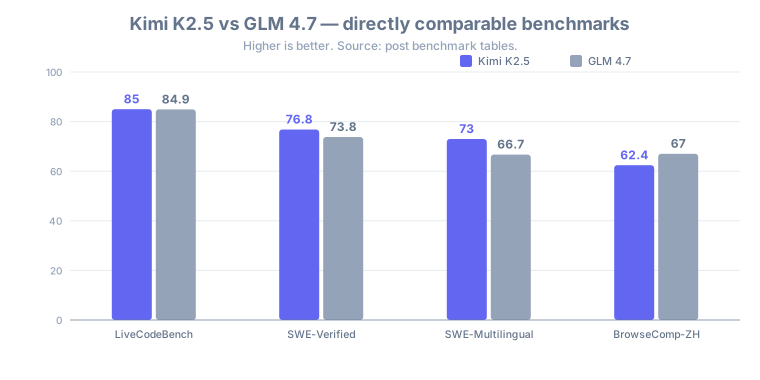
| Benchmark | Kimi K2.5 | GLM 4.7 | Winner |
|---|---|---|---|
| LiveCodeBench (v6) | 85.0 | 84.9 | Kimi K2.5 (slight) |
| SWE-Bench Verified | 76.8 | 73.8 | Kimi K2.5 |
| SWE-Bench Multilingual | 73.0 | 66.7 | Kimi K2.5 |
Reasoning Tasks
Complex Reasoning Example:

Problem: A company has 3 departments. Dept A has 50 employees,
Dept B has 30% more than A, and Dept C has half the combined
total of A and B. What's the total employee count?

Kimi K2.5 Solution:
1. Dept A = 50
2. Dept B = 50 × 1.30 = 65
3. Combined A+B = 115
4. Dept C = 115 / 2 = 57.5 → 58
5. Total = 50 + 65 + 58 = 173 employees

GLM 4.7 Solution:
Similar correct solution with comparable reasoning chain.
Context Window Analysis
Long Context Capabilities
| Feature | Kimi K2.5 | GLM 4.7 |
|---|---|---|
| Max Context | 256K tokens | 200K tokens |
| "Needle in Haystack" | Excellent | Good |
| Document Processing | 500+ pages | ~500 pages |
| Codebase Analysis | Entire large repos | Large repos (smaller margin) |
Context Efficiency Test
# Testing long-context recall
def test_context_recall(model, context_length):
    """
    Practical takeaway from official specs:
    - Kimi K2.5 max context: 256K
    - GLM 4.7 max context: 200K
    - GLM 4.7 max output: 128K
    Exact recall % depends on prompt and eval harness.
    """
    pass
Multilingual Capabilities
Chinese Language Performance
| Task | Kimi K2.5 | GLM 4.7 |
|---|---|---|
| Chinese Comprehension | Excellent | Excellent |
| Chinese Writing | Excellent | Excellent |
| Classical Chinese | Good | Very Good |
| Chinese-English Translation | Excellent | Excellent |
Other Languages
| Language | Kimi K2.5 | GLM 4.7 |
|---|---|---|
| English | Excellent | Very Good |
| Japanese | Good | Good |
| Korean | Good | Good |
| European Languages | Very Good | Good |
Specialized Features
Kimi K2.5 Unique Features
| Feature | Description |
|---|---|
| Agent Swarm | Up to 100 sub-agents |
| 256K Context | Industry-leading context window |
| Thinking Mode | Explicit reasoning chains |
| Vision Capabilities | Native multimodal support |
| Open Weights | Full model weights available |
GLM 4.7 Unique Features
| Feature | Description |
|---|---|
| Interleaved Thinking + Tools | Reasoning and tool calls can be interleaved |
| MCP Support | Supports MCP services and streaming tool outputs |
| Long Output | Up to 128K output tokens |
| Context Cache | Native context-cache support |
| Enterprise Deployment | Cloud + private deployment options |
Deployment Options
API Access
| Provider | Kimi K2.5 | GLM 4.7 |
|---|---|---|
| Official API | Moonshot AI | Zhipu AI |
| OpenRouter | Available | Available |
| Pricing (1M tokens) | Check official pricing page | Check official pricing page |
Local Deployment
| Aspect | Kimi K2.5 | GLM 4.7 |
|---|---|---|
| Deployment Type | Open weights + API | API + private deployment |
| Minimum VRAM | Depends on quantization/runtime | Not publicly fixed in official docs |
| Engine Support | Community engines (e.g., vLLM) | Official enterprise deployment stack |
| Local Feasibility | Enterprise-grade hardware recommended | Enterprise/private route via vendor |
Use Case Recommendations
Choose Kimi K2.5 When:
✅ Processing very long documents (256K context) ✅ Building agent workflows (Agent Swarm support) ✅ Maximum reasoning accuracy is required ✅ Open-source flexibility is important ✅ Cost efficiency at scale matters
Choose GLM 4.7 When:
✅ Chinese agent/search tasks are a priority ✅ Interleaved reasoning + tool use is required ✅ MCP integration is part of your architecture ✅ Long output generation (up to 128K) matters ✅ You prefer Zhipu's private deployment route
Code Example Comparison
Python Code Generation
Prompt: "Write a Python function to implement binary search with error handling"
Kimi K2.5 Output:
def binary_search(arr, target):
    """
    Perform binary search on a sorted array.

    Args:
        arr: Sorted list of comparable elements
        target: Element to search for

    Returns:
        Index of target if found, -1 otherwise

    Raises:
        ValueError: If array is not sorted
        TypeError: If inputs are invalid
    """
    if not arr:
        return -1

    # Verify array is sorted
    if arr != sorted(arr):
        raise ValueError("Array must be sorted")

    left, right = 0, len(arr) - 1

    while left <= right:
        mid = (left + right) // 2

        if arr[mid] == target:
            return mid
        elif arr[mid] < target:
            left = mid + 1
        else:
            right = mid - 1

    return -1
GLM 4.7 Output:
def binary_search(arr, target):
    if not isinstance(arr, list):
        raise TypeError("Array must be a list")

    left, right = 0, len(arr) - 1

    while left <= right:
        mid = (left + right) // 2
        if arr[mid] == target:
            return mid
        elif arr[mid] < target:
            left = mid + 1
        else:
            right = mid - 1

    return -1
Analysis: Kimi K2.5 provides more comprehensive documentation and validation.
Performance at Scale
Throughput Comparison
| Metric | Kimi K2.5 | GLM 4.7 |
|---|---|---|
| Tokens/Second | Provider-dependent | Provider-dependent |
| First Token Latency | Deployment-dependent | Deployment-dependent |
| Concurrent Requests | Tier-dependent | Tier-dependent |
Cost Analysis (1M tokens/day)
| Model | Daily Cost | Monthly Cost |
|---|---|---|
| Kimi K2.5 | Depends on selected endpoint/tier | Depends on selected endpoint/tier |
| GLM 4.7 | Depends on selected endpoint/tier | Depends on selected endpoint/tier |
Community and Ecosystem
Open Source Activity
| Aspect | Kimi K2.5 | GLM 4.7 |
|---|---|---|
| HuggingFace Downloads | High | Very High |
| GitHub Stars | Growing | Established |
| Community Size | Expanding | Large |
| Documentation | Comprehensive | Extensive |
Integration Support
Both models provide OpenAI-compatible APIs and integrate with common orchestration frameworks:
- LangChain
- LlamaIndex
- OpenAI-compatible APIs
- Custom tool/function calling pipelines
Frequently Asked Questions
Which model has better coding capabilities?
In officially published numbers, Kimi K2.5 is slightly ahead on LiveCodeBench and SWE-Bench Verified, while GLM 4.7 remains highly competitive.
Is GLM 4.7 better for Chinese language tasks?
Both models excel at Chinese, but GLM 4.7 has slight advantages in classical Chinese and certain cultural contexts.
Can I run Kimi K2.5 on my local machine?
Kimi K2.5 open weights generally target high-end hardware for practical deployment. GLM 4.7 is primarily delivered via API/private deployment in official channels.
Which model is more cost-effective?
Pricing changes frequently on both platforms; check Moonshot and Zhipu official pricing pages before budgeting.
Does Kimi K2.5 support tool use?
Yes, Kimi K2.5 supports function calling and tool use, with the unique addition of Agent Swarm for multi-agent workflows.
Which model should I choose for long documents?
Kimi K2.5 has a larger context window (256K vs 200K), while GLM 4.7 also supports long-context workflows with up to 128K output.
Are both models fully open source?
Kimi K2.5 provides open weights under a Modified MIT License. GLM 4.7 uses Zhipu's model license and is commonly consumed through API/private deployment offerings.
Can I switch between models easily?
Yes, both models support OpenAI-compatible APIs and work with popular frameworks like LangChain, making switching straightforward.
Make an informed choice between Kimi K2.5 and GLM 4.7 based on your specific requirements for context length, deployment constraints, and specialized features.