If you're comparing Kimi K2.5 vs Kimi K2.6, the short answer is simpler than most posts make it sound: K2.6 is the better starting point for new coding and agent workflows, while K2.5 is the cheaper older option if you already have prompts, tooling, and costs tuned around it.
Moonshot's docs (re-checked on May 20, 2026) still put the two models in slightly different camps. K2.6 is the new flagship, and the one Moonshot keeps talking up whenever the topic is long-horizon coding, tighter instruction following, or better self-correction. K2.5, meanwhile, is still the broad all-rounder and still shows up as the default example across plenty of pages.
So this isn't a "new model good, old model bad" piece. It's a tradeoff piece. Some teams really should move right now. Others genuinely shouldn't bother yet.
New to Kimi K2.6? Try Kimi K2.6 for free.
Kimi K2.5 vs Kimi K2.6: Short Answer
Go with K2.6 if you're spinning up a new coding assistant or agent product, your biggest pain is long-session reliability rather than context size, you want Moonshot's newest pick for software engineering work, or you care about tighter instruction compliance and self-correction.
K2.5 still makes sense if your current workflow is tuned and working, if the lower token price matters more than the newer model behavior, or if you'd rather stay on the more documented, better-trodden path a little longer.
Kimi K2.5 vs Kimi K2.6: Pricing at a Glance
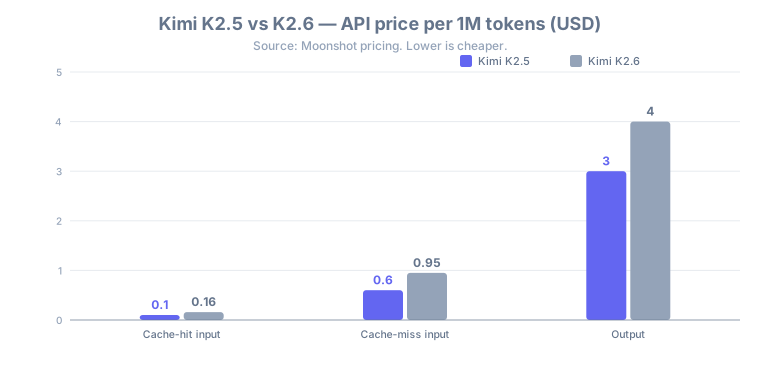
| Model | Cache Hit Input | Cache Miss Input | Output | Batch API |
|---|---|---|---|---|
| Kimi K2.5 | $0.10 | $0.60 | $3.00 | Supported |
| Kimi K2.6 | $0.16 | $0.95 | $4.00 | Supported |
Kimi K2.5 vs Kimi K2.6: At a Glance
| Aspect | Kimi K2.5 | Kimi K2.6 |
|---|---|---|
| Positioning | Most versatile Kimi model; framed as open-source SoTA in the docs | Latest and most intelligent Kimi model |
| Best fit | Broad multimodal + agent use, established workflows | Long-horizon coding and more autonomous agents |
| Context window | 256K | 256K |
| Input types | Text, image, video | Text, image, video |
| Thinking / non-thinking | Yes | Yes |
| Dialogue + agent tasks | Yes | Yes |
| OpenAI-compatible API | Yes | Yes |
| Tool calling | Yes | Yes |
| Batch API | Supported | Supported |
| Main upgrade story | Strong all-rounder | Better coding stability, compliance, self-correction, agent execution |
What Actually Changed from K2.5 to K2.6
The most common misread of K2.6 is that it's basically a bigger context window. It isn't.
Both K2.5 and K2.6 ship with a 256K context — same number, same ceiling. So if your one gripe with K2.5 was "I just need a larger window", K2.6 won't move the needle for you.
What K2.6 does change is the quality of long-running work — steadier code output over long sessions, tighter instruction compliance, better self-correction, more robust handling of complex engineering tasks, and more reliable autonomous agent execution.
Moonshot's K2.6 guide is unusually specific about where the generalization improved: Rust, Go, Python, frontend, DevOps, and performance optimization all get explicit shout-outs. That's much more concrete than the usual "model is better overall" line. The implication is pretty clear: if your real workload is multi-step implementation, K2.6 is the version designed to hold up longer before drifting.
What Stayed the Same
This is the part a lot of comparison posts gloss over. On the surface, K2.5 and K2.6 are still very close to each other.
Both are native multimodal models. Both accept text, image, and video input. Both support thinking and non-thinking modes, dialogue and agent tasks, and expose the same OpenAI-compatible Chat Completions interface. Both are documented as supporting ToolCalls, JSON Mode, Partial Mode, internet search, and automatic context caching in the pricing docs.
Practically, this means if you've already integrated K2.5 cleanly, moving to K2.6 is much closer to a model swap than a platform rewrite.
API and Tooling Differences That Matter in Practice
The K2.6 quickstart guide is worth reading closely, mostly because the behavior it documents applies to both K2.6 and K2.5.
Shared request-body quirks
Moonshot recommends leaning on the defaults for K2.6/K2.5 instead of forcing generic sampling settings across them:
max_tokensdefaults to 32768thinkingdefaults to{"type": "enabled"}temperature,top_p,n,presence_penalty, andfrequency_penaltyall use fixed, model-specific behavior, and forcing unsupported values will error out
Shared tool-calling constraints
When thinking is enabled on either K2.6 or K2.5:
tool_choiceshould stay onautoornonereasoning_contentneeds to be preserved across multi-step tool calls- The builtin
$web_searchcurrently doesn't play well with thinking mode, so Moonshot suggests turning thinking off first if you need that builtin tool
The upshot: K2.6 isn't "more flexible" at the parameter layer. What it gives you is better output behavior under the same interface constraints, not broader request-shape freedom.
Where K2.5 Still Has a Real Edge
K2.6 is newer, but that doesn't make K2.5 a relic. There are still a few places where staying on K2.5 is genuinely the better call.
K2.5 is the more "established" default in current docs. A lot of Moonshot's pages still use K2.5 as the example model. If you want lower migration risk, if your team follows the docs closely, or if you'd prefer the path with the most worked examples today, K2.5 is the smoother landing.
K2.5 is still meaningfully cheaper. That remains the cleanest practical edge. K2.5 costs less on cache-hit input, cache-miss input, and output tokens, so mature K2.5 production flows still have a solid economic argument behind them.
K2.5's docs still foreground frontend quality and design expressiveness. The K2.5 quickstart leans hard on frontend code quality and design output. K2.6's docs pull in the opposite direction — toward long-horizon stability and complex engineering execution. That maps to a useful practical split: K2.5 is still excellent for broad, multimodal, frontend-heavy work, while K2.6 fits better when the job looks more like a persistent software engineer than a single-turn generator.
When Should You Upgrade from K2.5 to K2.6?
Time to upgrade if any of these sound familiar: "K2.5 starts strong but drifts during long coding sessions." "We need better adherence to detailed instructions." "We want the newest Moonshot coding model, not the safest old default." "Our agent workflow kind of works, but it still needs too much babysitting."
On the other hand, stay put on K2.5 for now if your prompts are heavily tuned and things are working, or if the cost of regression-testing a model swap outweighs whatever gain you'd expect today.
A Better Framing: K2.5 vs K2.6 by Use Case
K2.5 is still the right pick for existing production flows you don't want to destabilize, batch workloads, teams following current Moonshot examples closely, or general multimodal work where K2.5 is already doing the job.
K2.6 is the better pick for new coding copilots, long-running implementation tasks, agent products where autonomous execution quality matters, and any team that's optimizing for "less drift over time" rather than just "a good first response".
Final Verdict
K2.5 vs K2.6 is not a platform reset. It's a workflow decision.
The shared surface is still very familiar: 256K context, multimodal input, tool use, thinking and non-thinking modes, OpenAI-compatible access. What's really changed is where Moonshot is putting its weight. K2.6 is the model for longer engineering runs and steadier agent behavior. K2.5 is the safer, better-documented default.
If you're building from scratch in 2026, I'd start with K2.6. If K2.5 is already in production and behaving, I wouldn't swap until the real pain is drift in long sessions — not just the existence of a newer version.