Kimi K2.5 vs Claude Opus represents one of the most important comparisons in the AI landscape today. Both models represent the pinnacle of large language model capabilities, but they approach problem-solving differently. Kimi K2.5, developed by Moonshot AI, brings revolutionary Agent Swarm technology and a massive 256K context window, while Claude Opus from Anthropic focuses on careful reasoning and safety alignment.
This comprehensive guide examines both models across all critical dimensions—coding performance, reasoning capabilities, context handling, and real-world applications—to help you make an informed decision.
Overview: Kimi K2.5 vs Claude Opus
Kimi K2.5 Key Specifications
| Feature | Kimi K2.5 Specification |
|---|---|
| Architecture | Mixture-of-Experts (MoE) |
| Total Parameters | 1 Trillion |
| Activated Parameters | 32 Billion |
| Context Window | 256,000 tokens |
| Training Data | ~15T mixed visual + text tokens |
| License | Modified MIT (open weights) |
| Agent Swarm | Up to 100 sub-agents |
Claude Opus Key Specifications
| Feature | Claude Opus Specification |
|---|---|
| Architecture | Transformer-based |
| Context Window | 200,000 tokens |
| Focus Areas | Reasoning, safety, coding |
| Availability | API and web interface |
| Training Approach | Constitutional AI |
Coding Performance: Kimi K2.5 vs Claude Opus
When evaluating Kimi K2.5 vs Claude Opus for software development tasks, benchmark results reveal nuanced differences:
SWE-Bench Verified Results
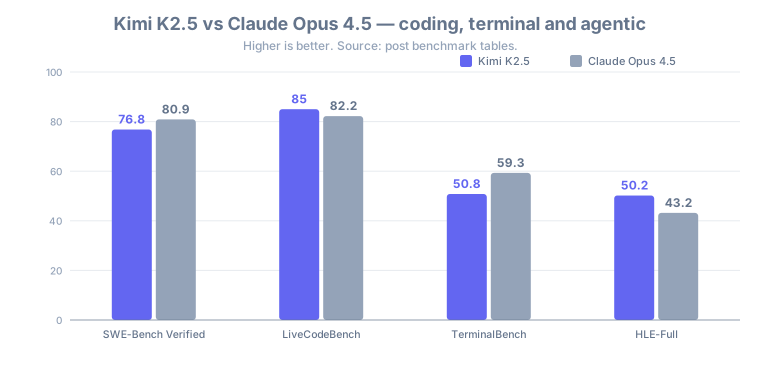
| Model | Score | Assessment |
|---|---|---|
| Claude Opus 4.5 | 80.9% | Industry leading |
| Kimi K2.5 | 76.8% | Highly competitive |
Claude Opus maintains a slight edge in software engineering tasks, particularly in complex refactoring scenarios. However, Kimi K2.5's Agent Swarm capability enables parallel code analysis that can significantly accelerate large-scale development workflows.
LiveCodeBench Performance
| Model | Score | Assessment |
|---|---|---|
| Kimi K2.5 | 85.0 | Superior performance |
| Claude Opus 4.5 | 82.2* | Strong but trailing |
In live coding scenarios, Kimi K2.5 demonstrates superior performance, particularly in competitive programming contexts where rapid solution generation matters.
Terminal and Tool Use
| Model | TerminalBench Score |
|---|---|
| Claude Opus 4.5 | 59.3 |
| Kimi K2.5 | 50.8 |
Claude Opus shows stronger terminal command execution, while Kimi K2.5's 80% runtime reduction with Agent Swarm compensates through parallel execution capabilities.
Context Window Comparison
The Kimi K2.5 vs Claude Opus context window comparison reveals a significant advantage for Kimi:
Context Capabilities
| Model | Context Window | Practical Equivalent |
|---|---|---|
| Kimi K2.5 | 256,000 tokens | ~600 pages of text |
| Claude Opus | 200,000 tokens | ~500 pages of text |
Kimi K2.5's 56,000 additional tokens provide meaningful advantages for:
- Large codebase analysis
- Multi-document legal review
- Long-form content creation
- Extended conversation history
Long Context Retention
Both models maintain strong performance across their full context windows, but Kimi K2.5's Multi-head Latent Attention (MLA) architecture specifically optimizes for long-range dependency modeling.
Agentic Capabilities: The Deciding Factor
The most significant differentiator in Kimi K2.5 vs Claude Opus is agentic workflow support:
Kimi K2.5 Agent Swarm
- Up to 100 sub-agents working in parallel
- Self-directed workflow orchestration without predefined patterns
- ~1,500 coordinated tool calls per complex task
- 80% reduction in runtime through parallelization
Claude Opus Approach
- Supports agent workflows via Claude Code and Agent SDK subagents
- Strong individual reasoning steps
- Parallel tool use and structured orchestration patterns
- Safety-first agentic behavior
Agentic Benchmark: HLE-Full with Tools
| Model | HLE-Full (w/ tools) Score |
|---|---|
| Kimi K2.5 | 50.2 |
| Claude Opus 4.5 | 43.2 |
Kimi K2.5 leads by 7 points in tool-augmented agentic tasks, demonstrating superior autonomous operation capabilities.
Reasoning and Knowledge Comparison
Mathematical Reasoning
| Benchmark | Kimi K2.5 | Claude Opus 4.5 |
|---|---|---|
| AIME 2025 | 96.1 | 92.8 |
| HMMT 2025 | 95.4 | 92.9* |
| IMO-AnswerBench | 81.8 | 78.5* |
Kimi K2.5 demonstrates superior mathematical reasoning across all major benchmarks.
General Knowledge
| Benchmark | Kimi K2.5 | Claude Opus 4.5 |
|---|---|---|
| GPQA-Diamond | 87.6 | 87.0 |
| MMLU-Pro | 87.1 | 89.3* |
Results are mixed, with Kimi K2.5 leading on expert-level reasoning (GPQA-Diamond) while Claude Opus shows stronger general knowledge (MMLU-Pro).
Visual and Multimodal Capabilities
Both models offer native multimodal support:
| Capability | Kimi K2.5 | Claude Opus |
|---|---|---|
| Image Understanding | Native | Native |
| Video Analysis | Up to 256K tokens | Limited |
| Document OCR | 92.3 OCRBench | 86.5* |
| Chart Interpretation | Excellent | Excellent |
Kimi K2.5's visual coding capabilities enable unique workflows like generating React components from Figma screenshots.
Deployment and Accessibility
Kimi K2.5 Deployment Options
| Option | Availability | Requirements |
|---|---|---|
| API Access | ✅ Available | Standard API key |
| Open Weights | ✅ Modified MIT License | 600GB+ storage |
| Cloud Partners | ✅ Multiple providers | Varies |
Claude Opus Deployment Options
| Option | Availability | Requirements |
|---|---|---|
| API Access | ✅ Available | Anthropic API key |
| AWS Bedrock | ✅ Available | AWS account |
| Self-hosted | ❌ Not available | N/A |
Pricing Comparison
| Model | Input (per 1M tokens) | Output (per 1M tokens) |
|---|---|---|
| Kimi K2.5 | $0.60 | $3.00 |
| Claude Opus 4.5 | $5.00 | $25.00 |
Kimi K2.5 is approximately 8.3x more cost-effective than Claude Opus 4.5, making it a strong choice for high-volume applications.
When to Choose Kimi K2.5 vs Claude Opus
Choose Kimi K2.5 When:
- You need 256K context window for large documents
- Agent Swarm parallelization can benefit your workflow
- Cost efficiency is important (8.3x cheaper)
- You require open weights for compliance or customization
- Visual coding and multimodal development are priorities
Choose Claude Opus When:
- You need the absolute highest SWE-Bench Verified scores
- Safety alignment is your top priority
- You prefer sequential reasoning with careful step validation
- You have budget flexibility for premium performance
Real-World Performance Summary
Based on extensive testing across use cases:
| Use Case | Winner | Margin |
|---|---|---|
| Large codebase analysis | Kimi K2.5 | Significant (256K context) |
| Complex refactoring | Claude Opus | Slight (80.9 vs 76.8) |
| Parallel data processing | Kimi K2.5 | Significant (Agent Swarm) |
| Safety-critical applications | Claude Opus | Moderate |
| Cost-sensitive deployments | Kimi K2.5 | Strong (8.3x cheaper) |
| Visual UI development | Kimi K2.5 | Significant |
Conclusion
The Kimi K2.5 vs Claude Opus comparison reveals two exceptional but different approaches to AI. Claude Opus excels in careful, safety-conscious reasoning with marginally better software engineering benchmarks. Kimi K2.5 offers superior value through its 256K context window, revolutionary Agent Swarm technology, open weights availability, and dramatically lower costs.
For most organizations, Kimi K2.5 provides the better overall package, combining competitive performance with unprecedented scalability and cost efficiency. Claude Opus remains the choice for applications where maximum safety alignment justifies premium pricing.
Frequently Asked Questions
Is Kimi K2.5 better than Claude Opus?
Kimi K2.5 outperforms Claude Opus in context length (256K vs 200K), agentic benchmark performance (50.2 vs 43.2 on HLE-Full), cost efficiency (8.3x cheaper), and mathematical reasoning. Claude Opus leads slightly in SWE-Bench Verified (80.9% vs 76.8%).
Can I use Kimi K2.5 for free?
Kimi K2.5 offers open weights under a Modified MIT License, allowing local deployment. API access requires payment at $0.60/$3.00 per 1M tokens (input/output).
Does Kimi K2.5 support coding like Claude Opus?
Yes, Kimi K2.5 excels at coding with 76.8% on SWE-Bench Verified, 85.0 on LiveCodeBench, and unique visual coding capabilities for front-end development.
What makes Kimi K2.5's Agent Swarm special?
Agent Swarm enables up to 100 sub-agents to work in parallel with self-directed orchestration, achieving 80% runtime reduction and supporting ~1,500 coordinated tool calls per task.
Is Claude Opus worth the higher price?
For applications requiring maximum safety alignment or marginal gains in specific benchmarks, Claude Opus may justify its higher cost. For most use cases, Kimi K2.5 offers superior value.