Before comparing Kimi K2.6 with Claude — especially Claude Opus 4.7 — it helps to realize there are really two questions bundled together.
First: what does Moonshot's K2.6 benchmark table say on the comparisons it actually makes? Second: what does Anthropic say about Opus 4.7, which is newer than the Claude model in Moonshot's table?
The distinction matters. As of April 21, 2026, Moonshot's K2.6 table compares against Claude Opus 4.6, while Anthropic's newest flagship page is already for Claude Opus 4.7. So if anyone claims they have a fully clean K2.6 vs Opus 4.7 apples-to-apples table, slow down — I didn't find one in the primary sources for this post.
New to Kimi K2.6? Try Kimi K2.6 for free.
Short Answer
Kimi K2.6 is the right call if you want much lower published API pricing than Opus 4.7, want the model Moonshot explicitly positions for long-horizon coding and agent workflows, care about price/performance for coding-heavy and tool-heavy work, or want strong multimodality — text, image, and video — on the same Kimi line.
Claude Opus 4.7 is the right call if you want Anthropic's current premium flagship, the strongest Claude for complex coding and long-running agents, the 1M context window, and you're willing to pay a premium for frontier proprietary performance.
Kimi K2.6 vs Claude Opus 4.7: At a Glance
| Aspect | Kimi K2.6 | Claude Opus 4.7 |
|---|---|---|
| Model positioning | Moonshot’s latest and most intelligent Kimi model | Anthropic’s premium frontier coding and agent model |
| Context window | 262,144 tokens | 1M context window |
| Input pricing | $0.95 / 1M cache-miss input | $5 / 1M input |
| Cached input pricing | $0.16 / 1M cache-hit input | Anthropic says up to 90% savings with prompt caching |
| Output pricing | $4 / 1M output | $25 / 1M output |
| Input types | Text, image, video | Anthropic highlights coding, agents, and improved vision |
| Thinking modes | Thinking + non-thinking | Adaptive thinking |
| Agent positioning | Dialogue + agent tasks, stronger autonomous execution | Professional software engineering and complex agentic workflows |
The Pricing Difference Is Huge
Pricing is the one dimension where you can do a clean, unambiguous comparison, because both vendors publish list numbers.
Moonshot's K2.6 pricing page lists $0.16 for cache-hit input, $0.95 for cache-miss input, and $4.00 for output.
Anthropic's Opus 4.7 page lists $5 per million input tokens and $25 per million output tokens.
Stacked side by side on fresh input and output, K2.6's input comes in roughly 5.3x cheaper and its output roughly 6.25x cheaper than Opus 4.7. If cost is a real factor in your decision, K2.6 becomes hard to ignore at that gap.
Context Window: Claude Opus 4.7 Has the Clear Edge
On raw context size, Opus 4.7 wins cleanly in the docs — Kimi K2.6 at 262,144 tokens vs Claude Opus 4.7 at a 1M context window.
If your workflow revolves around huge codebases, enormous multi-file review sessions, or multi-day accumulated context, Opus 4.7's context story is the more ambitious one.
That said, context size isn't the same as price/performance. Bigger window doesn't automatically mean better tradeoff.
Kimi K2.6 vs Claude on Shared Benchmarks
Here's where we have to be precise. Moonshot's K2.6 benchmark table compares K2.6 with Claude Opus 4.6 — not 4.7.
From Moonshot's table:
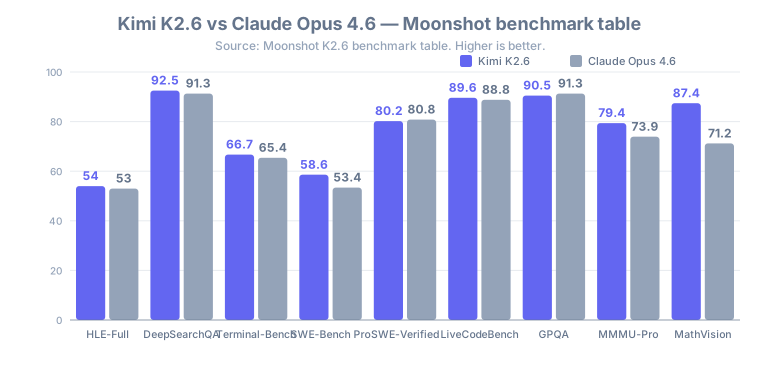
| Benchmark | Kimi K2.6 | Claude Opus 4.6 |
|---|---|---|
| HLE-Full w/ tools | 54.0 | 53.0 |
| DeepSearchQA (f1) | 92.5 | 91.3 |
| Terminal-Bench 2.0 | 66.7 | 65.4 |
| SWE-Bench Pro | 58.6 | 53.4 |
| SWE-Bench Verified | 80.2 | 80.8 |
| LiveCodeBench (v6) | 89.6 | 88.8 |
| GPQA-Diamond | 90.5 | 91.3 |
| MMMU-Pro | 79.4 | 73.9 |
| MathVision | 87.4 | 71.2* |
Against Opus 4.6, K2.6 is very far from being a generic underdog. It takes the lead on a long list of coding, tool, and multimodal items, while staying within arm's reach on SWE-Bench Verified.
What Anthropic Says About Opus 4.7
Anthropic's Opus 4.7 pages pitch the model as a hybrid reasoning model, built for professional software engineering and complex agentic workflows, and positioned as more thorough and consistent than Opus 4.6 on difficult work.
They put concrete numbers behind that: Opus 4.7 improves over Opus 4.6 by 13% on Anthropic's internal 93-task coding benchmark, lands 70% on CursorBench vs 58% for Opus 4.6, and reports better internal research-agent efficiency and long-context consistency.
Which is exactly why you shouldn't read Moonshot's K2.6 vs Opus 4.6 table and assume K2.6 would beat Opus 4.7 in the same shape. The safest read is: K2.6 already looks highly competitive with Opus 4.6; Opus 4.7 is clearly a stronger Claude than Opus 4.6; and a clean K2.6 vs Opus 4.7 public table wasn't found in the primary sources used for this post.
So Who Wins for Coding?
If you want the most conservative answer strictly from primary sources: Kimi K2.6 already looks excellent on coding and tool benchmarks on Moonshot's side, and Claude Opus 4.7 is clearly Anthropic's strongest coding and agent model on Anthropic's side.
In other words, the real answer depends on what you're optimizing for.
K2.6 wins when price/performance matters, when you want more value per token, when you want strong long-horizon coding without paying Opus pricing, or when you're satisfied that K2.6 is already publicly benchmarked close to Claude Opus 4.6.
Opus 4.7 wins when you want Anthropic's absolute premium option, when you need 1M context, when you want the newest Claude flagship for long-running engineering work, or when budget isn't the primary constraint.
Kimi K2.6 vs Claude for Agent Work
Both vendors have leaned hard into the agent narrative with these models.
Moonshot's K2.6 pitch is stronger autonomous execution, long-horizon coding reliability, proactive agent workflows, and strong results on HLE-Full w/ tools and DeepSearchQA.
Anthropic's Opus 4.7 pitch is stronger multi-tool orchestration, better long-running workflow reliability, improved planning and tool-call behavior, and strong enterprise and research-agent positioning.
Framed that way, this really isn't a "chat model vs chat model" comparison — it's closer to a workflow architecture choice. K2.6 is the stronger cost-performance option; Opus 4.7 is the premium frontier spend.
Final Verdict
The cautious read is pretty clean. Kimi K2.6 is much cheaper by list price. Claude Opus 4.7 has the bigger context story and the more premium positioning. Moonshot's own table already puts K2.6 running close to Opus 4.6, and Anthropic's own pages make clear that Opus 4.7 is a real step up from 4.6.
From there, the recommendation is straightforward: pick K2.6 when cost-performance and strong coding or agent work matter most; pick Opus 4.7 when you want the top-tier Claude path and the higher spend is acceptable.